GMAT Focus Data Insights Strategy: Why Critical Reasoning Skills Can Improve Your ScoreThe GMAT Focus Edition has changed the way MBA aspirants prepare for business school admissions. Among the three sections of the exam, the Data Insights section has gained significant attention because it measures a candidate's ability to analyze information, evaluate data, and make informed decisions. Many students assume that success in this section depends mainly on mathematical ability. However, candidates who consistently score well understand that logical thinking and Critical Reasoning skills are equally important.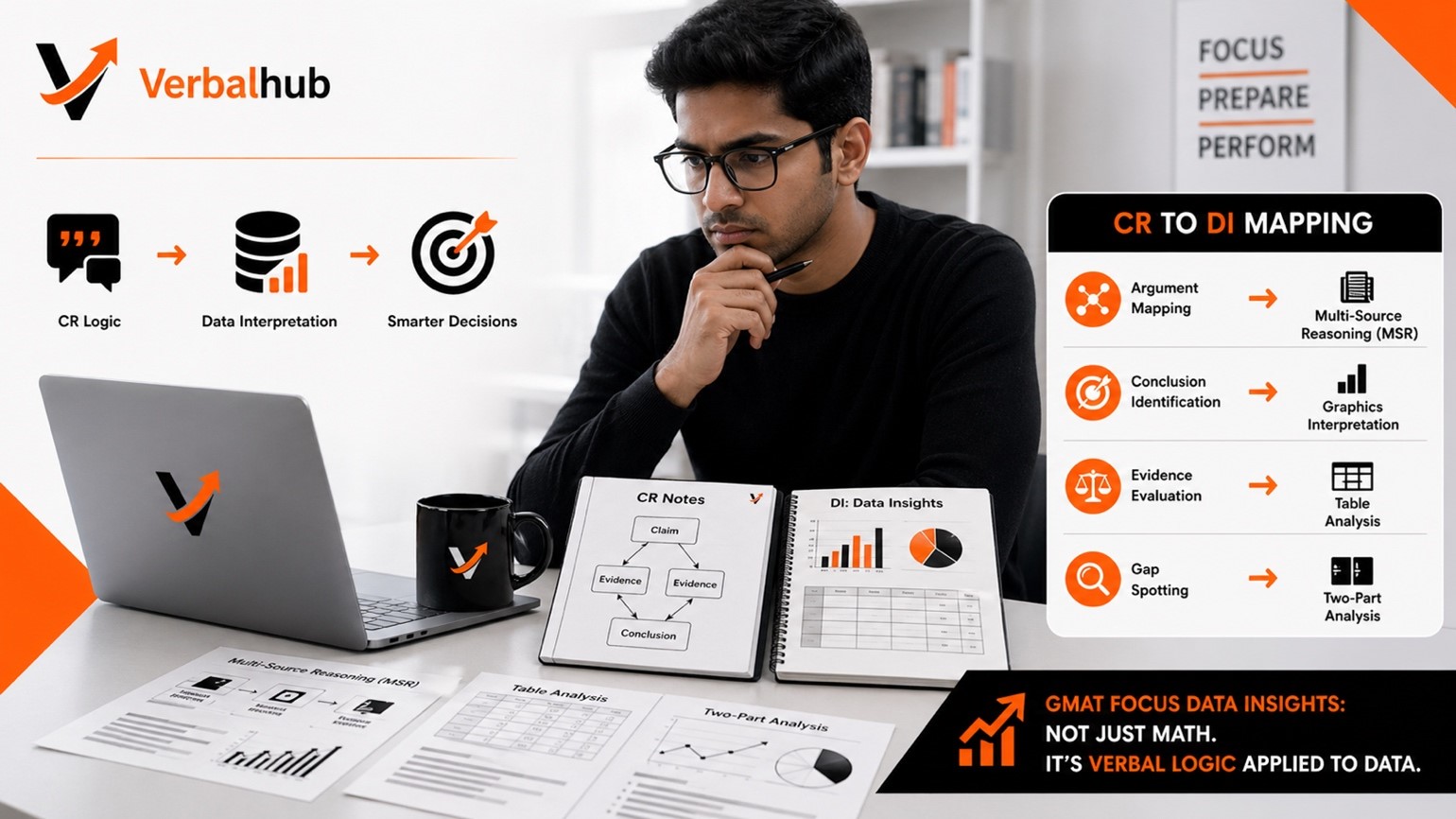
A successful GMAT Focus Data Insights Strategy goes beyond formulas and calculations. It requires candidates to identify patterns, evaluate evidence, recognize assumptions, and interpret information accurately. These are the same skills tested in Critical Reasoning questions. This is why students with strong reasoning abilities often perform better in Data Insights than those who rely solely on quantitative knowledge.Understanding the Role of Logic in Data InsightsThe Data Insights section is designed to reflect real-world business decision-making. Instead of testing only mathematical concepts, it evaluates how effectively candidates can process information from different sources and arrive at logical conclusions. Questions may include tables, graphs, charts, and multiple information sources that must be analyzed carefully before selecting an answer. One of the biggest challenges students face is dealing with large amounts of information under time pressure. Many candidates spend too much time performing calculations when the actual solution requires logical analysis. In many cases, understanding the relationship between data points is more important than solving complex mathematical equations. This is where Critical Reasoning skills become valuable. Students who can quickly identify relevant information and eliminate irrelevant details are often able to solve Data Insights questions more efficiently. Rather than getting lost in numbers, they focus on understanding what the data is actually saying. Why Critical Reasoning Improves Data Insights PerformanceThere is a strong connection between Critical Reasoning and Data Insights. Both sections require candidates to evaluate information objectively and make decisions based on evidence. In Critical Reasoning, students analyze arguments, identify assumptions, and assess conclusions. In Data Insights, they perform a similar process using numerical and visual information. For example, a Data Insights question may present multiple data sources and ask candidates to determine which conclusion is best supported by the available information. This task is very similar to evaluating an argument in Critical Reasoning. Candidates must separate facts from assumptions and avoid drawing conclusions that are not supported by the data. Another benefit of Critical Reasoning is improved answer elimination. Many GMAT questions are designed to include attractive but incorrect options. Students with strong reasoning skills can quickly identify logical flaws in answer choices, improving both speed and accuracy. Common Mistakes Students Make in Data InsightsMany aspirants struggle in the Data Insights section because they approach it as a traditional Quantitative section. One common mistake is focusing excessively on calculations. While numerical understanding is important, many questions can be solved through logical interpretation rather than lengthy mathematical work. Another common error is failing to identify the actual objective of the question. Students often begin analyzing data before fully understanding what they are being asked to find. This leads to wasted time and unnecessary confusion. Time management is another challenge. Because Data Insights questions can appear complex, candidates sometimes spend too much time on a single question. Learning to evaluate information strategically and eliminate incorrect options can significantly improve efficiency. Building an Effective GMAT Data Insights Preparation PlanStudents aiming for a high GMAT score should develop a preparation strategy that combines analytical reasoning with data interpretation skills. Instead of treating Data Insights and Critical Reasoning as separate subjects, it is beneficial to prepare them together. Regular practice is essential. Candidates should work on a variety of question types while focusing on understanding the reasoning behind each answer. Reviewing mistakes is equally important because it helps identify patterns and areas that need improvement. Mock tests also play a crucial role in preparation. They help students become comfortable with the exam format and improve their ability to manage time effectively. Consistent practice under timed conditions builds confidence and develops the decision-making skills required on test day. For students looking for expert guidance, VerbalHub provides specialized training programs focused on the GMAT Focus Edition. Through personalized mentoring, strategic study plans, and targeted practice sessions, students can strengthen both their Critical Reasoning and Data Insights skills. Resources available at VerbalHub help aspirants develop the analytical thinking required to achieve competitive GMAT scores. ConclusionThe Data Insights section of the GMAT Focus Edition is much more than a test of mathematical ability. It evaluates how effectively candidates can analyze information, identify patterns, and make logical decisions. This is why Critical Reasoning plays such an important role in achieving a high score. Students who focus on developing strong reasoning skills often find Data Insights questions easier to manage and solve more efficiently. By combining logical thinking with structured preparation, candidates can improve accuracy, save time, and maximize their overall GMAT performance. A well-planned GMAT Focus Data Insights Strategy can make a significant difference in achieving MBA admission goals and building confidence for the exam.
|

