Carsilk Car Mats
1 post
Jul 13, 2026
11:44 PM

|
What Are the Best Car Mats for Snow, Rain, and Mud?
Theodore Manzano's commute takes him past a construction site every morning, through a stretch of unpaved shoulder that turns into a genuine mud pit after rain, and straight into a mountain pass that gets serious snow for several months a year. His floor mats see more punishment in an average week than most drivers' mats see in a year, and after cycling through a couple of disappointing sets that couldn't keep up, he finally found a combination of material and design that actually held up to all three conditions without needing to be swapped out seasonally.
Theodore's situation is an extreme version of a common challenge: snow, rain, and mud each stress best car mats interiors in slightly different ways, and a mat that handles one well doesn't automatically handle the others. Finding a genuinely strong all-condition option means understanding what each of these three threats actually requires.
What Snow Demands From a Mat
Snow's main challenge isn't the snow itself but what it becomes once tracked into a warm cabin — slush and meltwater that pools in the footwell rather than staying frozen. This requires deep, reinforced containment edges capable of holding a meaningful volume of standing liquid, since snow melt often produces more runoff than a typical rainstorm. Cold temperatures also test material flexibility directly; materials prone to becoming brittle in freezing conditions are more likely to crack under the combined stress of cold and the physical impact of boots and shoes.
What Rain Demands From a Mat
Rain introduces less standing volume than snow melt typically does, but it happens more frequently across more of the year in most climates, making consistent water resistance more important than peak containment capacity alone. A surface that repels water effectively, paired with edges that handle routine splashing and dripping from wet shoes, covers most rain-related demands. Materials that dry quickly between exposures also matter here, since frequent rain means frequent wet-to-dry cycles that can degrade materials prone to trapping moisture.
What Mud Demands From a Mat
Mud combines the moisture challenge of rain with a physical debris challenge that neither snow nor rain typically presents to the same degree. A textured surface helps trap mud particles above the mat rather than letting them grind directly into a smooth surface, while a non-porous material prevents mud's moisture content from soaking in the way it would with carpet. Ease of cleaning becomes especially important here too, since dried mud can be considerably more stubborn to remove than a fresh liquid spill.
Why Eco-Leather Handles All Three Reasonably Well
Materials that perform consistently across all three conditions share water resistance, textured containment, and stability across a range of temperatures. Rubber handles snow and mud reasonably well but can become stiff and less pleasant underfoot in extended use, and its rigidity sometimes becomes a liability in very hot conditions during the rest of the year. Eco-leather tends to offer a more balanced combination — resisting moisture the way rubber does, remaining more flexible in cold temperatures than lower-grade rubber compounds, and offering a textured surface capable of containing mud and debris without sacrificing the material's overall refinement.

What to Look for When Buying for These Conditions Specifically
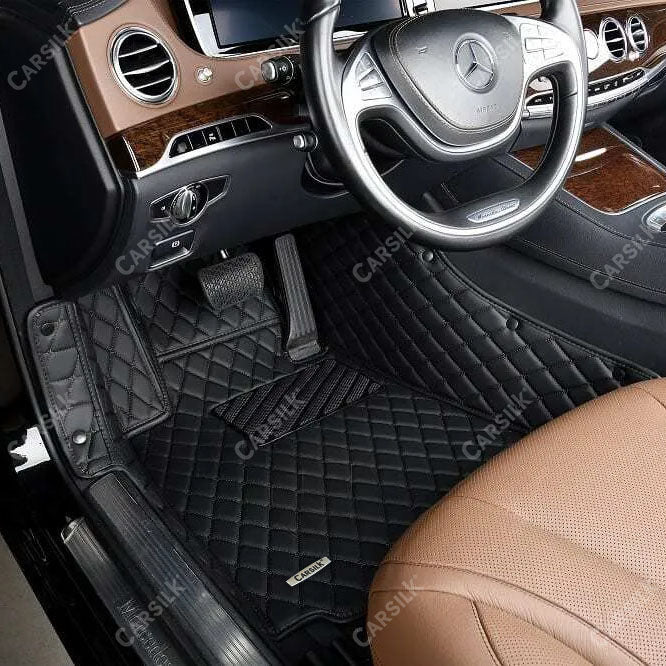
Given the combined demands of snow, rain, and mud, the strongest mats for this kind of use share a few specific traits: containment edges deep enough for real standing liquid, a non-porous surface that resists both water and mud moisture, textured detailing that traps debris rather than letting it grind in, and material flexibility that holds up across a genuine range of temperatures rather than just one season. CarSilk's eco-leather mats are built around this combination specifically, designed to handle the kind of demanding, multi-condition use Theodore's daily commute represents. For anyone facing a similarly demanding mix of conditions, the full collection is available at https://carsilks.com/collections/car-floor-mats-collection/.
Choosing One Mat Instead of Seasonal Swapping
The goal for most drivers dealing with snow, rain, and mud across a full year isn't finding three different specialized mats for three different conditions — it's finding one mat built to handle all three reasonably well, the way Theodore eventually did after a couple of disappointing attempts. Prioritizing containment depth, water resistance, textured debris control, and temperature flexibility together, rather than optimizing for just one condition, tends to produce a mat that holds up across whatever a full year of unpredictable weather actually brings.
Wondering how to apply this same thinking when choosing mats overall for your specific vehicle? Read next: How Do You Choose the Best Car Mats for Your Vehicle?
|
